
Have you ever looked at a product specification and wondered, how long is 300 mm? This measurement appears frequently in furniture dimensions, construction projects, electronics, office supplies, and household products. However, many people find it difficult to visualize 300 millimeters without a ruler or measuring tape.
The good news is that 300 mm is a very common length that can be compared to many everyday objects. Once you understand its size through familiar examples, estimating 300 mm becomes much easier.
In simple terms:
This means 300 mm is slightly shorter than 1 foot and about the length of a standard classroom ruler.
In this guide, you’ll learn exactly how long 300 mm is, how to visualize it, and which everyday objects can help you understand this measurement without needing any measuring tools.
What Does 300 mm Mean?
The abbreviation “mm” stands for millimeters, which are part of the metric system.
A millimeter is a small unit of length, and there are 1,000 millimeters in a meter. Because millimeters are so precise, they are commonly used in engineering, manufacturing, architecture, construction, and product design.
When converted into other units:
- 300 mm = 30 centimeters
- 300 mm = 0.3 meters
- 300 mm = 11.81 inches
- 300 mm = 0.98 feet
Although 300 mm may sound like a large number because of the three digits, it is actually a moderate length that most people encounter regularly.
How Long Is 300 mm Visually?
Many people understand measurements better through comparisons rather than numbers.
A length of 300 mm is roughly:
- The length of a standard ruler
- The longer side of an A4 sheet of paper
- Nearly one foot
- The width of many laptops
- About two smartphones placed end-to-end
Visual references help transform abstract measurements into something easy to imagine.
Instead of thinking about numbers, think about the common objects around you that are close to 300 mm long.
8 Common Objects That Are About 300 mm Long
1. A Standard School Ruler
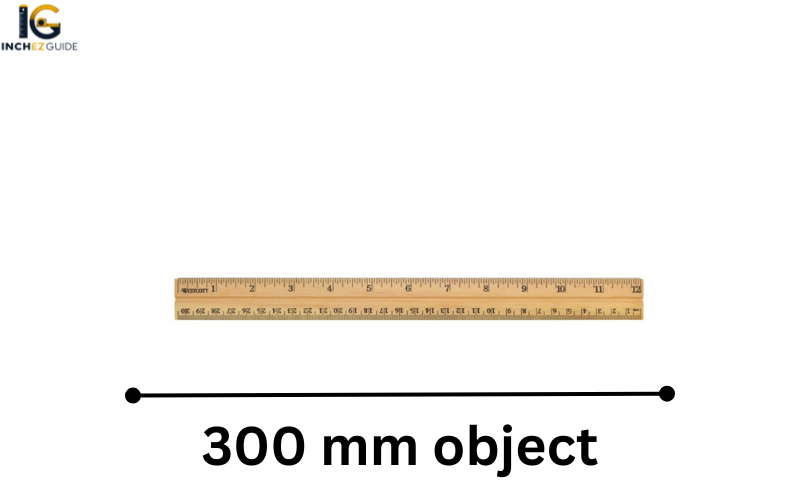
Perhaps the easiest way to visualize 300 mm is to think of a standard school ruler.
Most classroom rulers measure exactly 30 centimeters, which equals 300 millimeters. Students, teachers, architects, and engineers use these rulers daily for measurements and drawings.
Because rulers are specifically designed for measurement, they provide one of the most accurate visual examples of 300 mm.
If you’ve ever held a ruler in school, then you’ve already seen exactly how long 300 mm is.
The next time you need to estimate this measurement, simply imagine a standard ruler lying on a desk.
2. The Long Side of an A4 Sheet of Paper
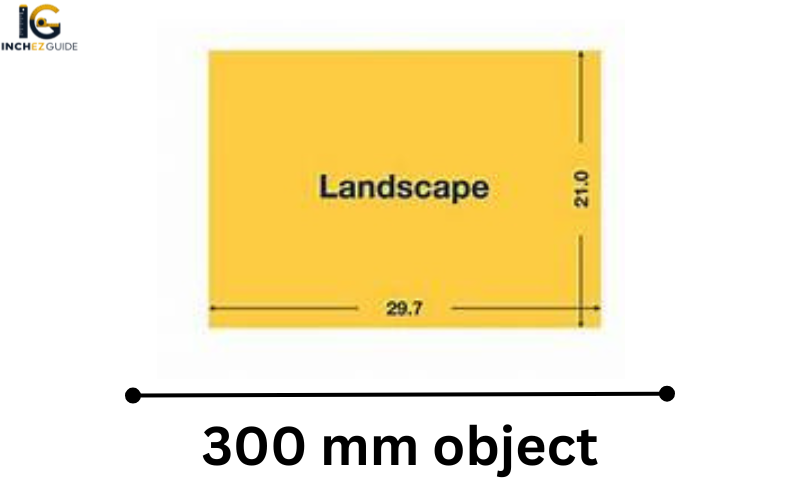
An A4 sheet is one of the most common paper sizes used worldwide.
Its dimensions are 210 mm × 297 mm.
That means the longer edge measures 297 mm, which is only 3 millimeters shorter than 300 mm.
This tiny difference is almost impossible to notice without measuring equipment.
Because paper is available in homes, schools, and offices, an A4 sheet provides a convenient way to understand the size of 300 mm.
When you look at the long edge of a sheet of paper, you’re essentially looking at a length very close to 300 mm.
3. A Compact Laptop
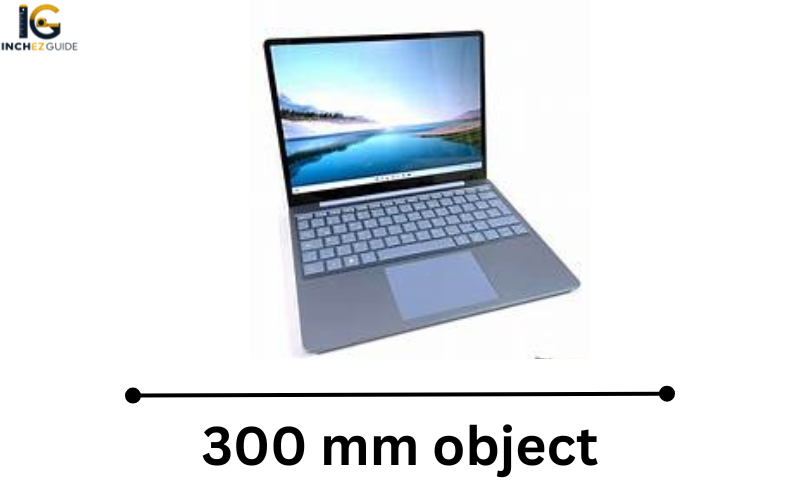
Many compact laptops have widths that range between 280 mm and 320 mm.
This makes them very similar in size to 300 mm.
For example, many 13-inch laptops are designed to be portable and lightweight while maintaining dimensions close to this measurement.
If you regularly carry a laptop in a backpack or briefcase, you already have a good understanding of what 300 mm looks like.
The width of a compact laptop can serve as an excellent everyday reference for estimating this measurement.
4. A Large Chef’s Knife
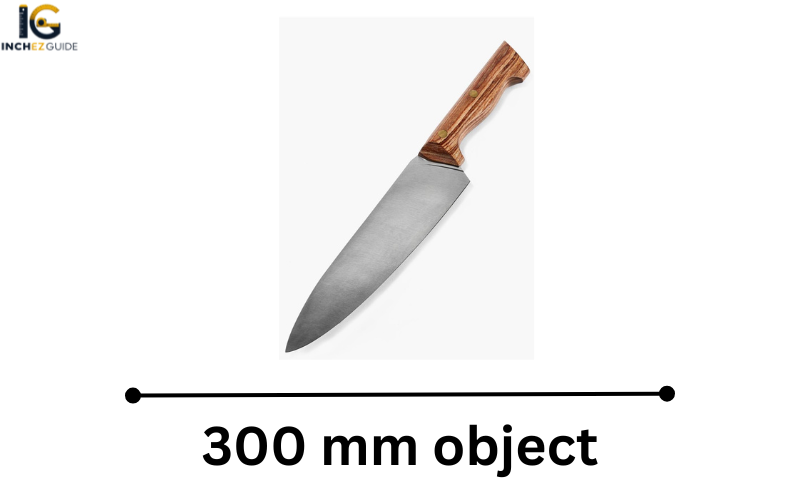
Many professional chef’s knives have an overall length close to 300 mm.
This includes both the blade and the handle.
Kitchen knives are designed to provide good balance and control, making this length ideal for many cooking tasks.
Because kitchens are full of objects with standardized dimensions, a chef’s knife becomes another useful reference when visualizing 300 mm.
Next time you’re preparing food, notice the size of a large kitchen knife and compare it to this measurement.
5. Two Smartphones Placed End-to-End
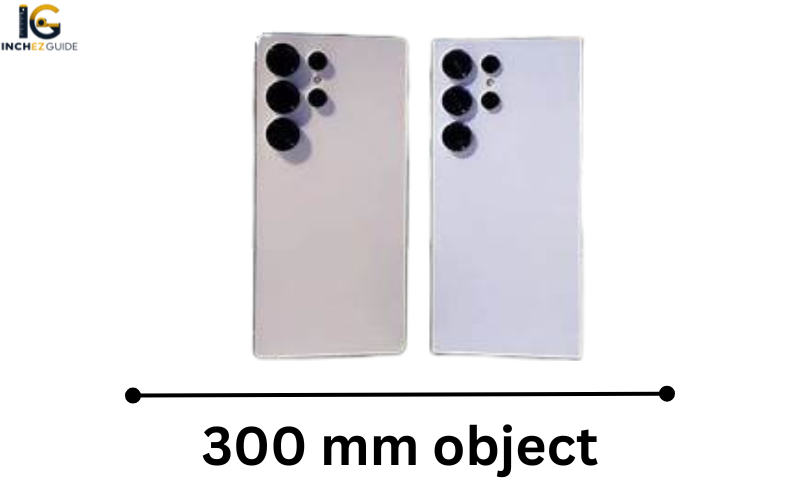
Modern smartphones usually measure between 145 mm and 165 mm in length.
When two smartphones are placed end-to-end, their combined length is close to 300 mm.
Since most people carry a smartphone every day, this comparison makes it easier to estimate 300 mm without any measuring tools.
Imagine laying two phones flat on a table. Their combined length gives you a very good representation of 300 mm.
This is one of the simplest ways to visualize the measurement using objects you already own.
6. A Compact Computer Keyboard
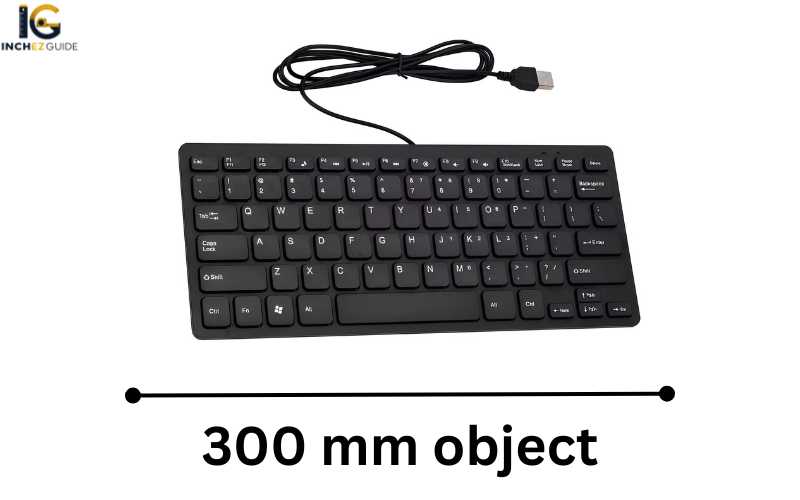
Many compact keyboards designed for offices and travel are approximately 300 mm wide.
Although full-size keyboards tend to be longer, compact models often stay close to this dimension.
If you spend time working at a desk, you’ve likely used a keyboard that measures around 300 mm across.
This makes office equipment another helpful visual comparison for understanding this length.
7. A Large Hardcover Book
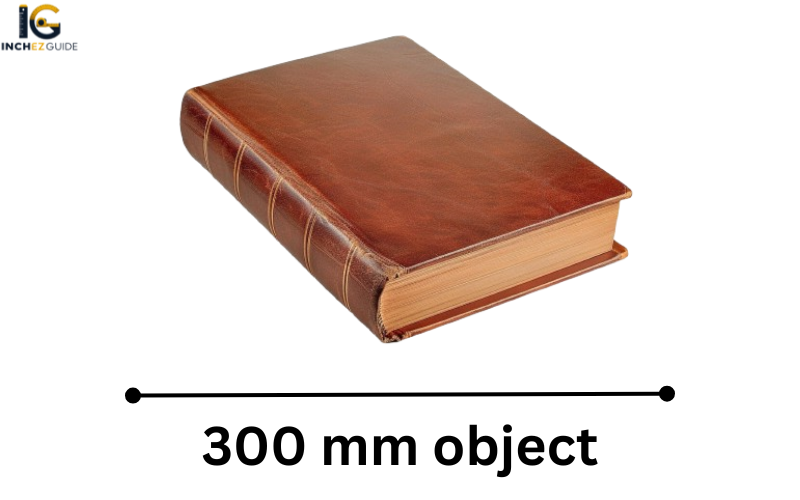
Many hardcover books, textbooks, and reference manuals measure close to 300 mm in height.
Large educational books often use dimensions that approach this measurement because they provide more space for text, charts, and images.
Books are excellent references because they maintain fairly consistent sizes.
If you’ve held a large textbook or coffee-table book, you’ve probably handled an object very close to 300 mm long.
8. A Small Guitar Neck Section
Certain sections of an acoustic or electric guitar neck measure approximately 300 mm.
Musical instruments are carefully designed using precise measurements, making them useful examples for understanding lengths and dimensions.
Even if you’re not a musician, you’ve likely seen a guitar and can imagine the size of its neck section.
This provides another practical way to visualize 300 mm.
Why Understanding 300 mm Is Important
Knowing how long 300 mm is can help in many situations.
Online Shopping
Many products list dimensions in millimeters.
Without understanding the actual size, it’s easy to order something larger or smaller than expected.
Understanding 300 mm helps you make better purchasing decisions when buying:
- Electronics
- Furniture
- Storage containers
- Office supplies
- Home décor items
DIY Projects
Home improvement projects often require accurate measurements.
Whether you’re cutting wood, installing shelves, or assembling furniture, understanding common measurements helps reduce mistakes.
Construction Work
Builders and contractors frequently work with metric measurements.
Knowing how long 300 mm is can improve planning and accuracy on construction projects.
Education
Students regularly encounter millimeters in mathematics, science, engineering, and technical drawing.
Visualizing measurements helps make learning easier.
How To Measure 300 mm Without a Ruler
There may be times when you need to estimate 300 mm but don’t have measuring tools nearby.
Fortunately, several common objects can help.
Use A Sheet Of A4 Paper
The long side measures approximately 297 mm.
This makes it almost identical to 300 mm.
Use A Laptop
Many compact laptops are close to this size.
Use Two Smartphones
Place them end-to-end for a quick estimate.
Use A Standard Ruler
Many rulers measure exactly 300 mm.
These simple methods can help estimate lengths accurately enough for everyday tasks.
300 mm Conversion Chart
The following chart shows how 300 mm compares with other common units.
| Measurement Unit | Equivalent |
| Millimeters | 300 mm |
| Centimeters | 30 cm |
| Meters | 0.3 m |
| Inches | 11.81 in |
| Feet | 0.98 ft |
Understanding these conversions is helpful when switching between metric and imperial measurement systems.
Is 300 mm Close To One Foot?
Yes, very close.
One foot equals:
This means 300 mm is only 4.8 mm shorter than a foot.
In everyday situations, most people consider 300 mm and 1 foot to be nearly the same length.
This is why many people use one foot as a quick visual reference for 300 mm.
Common Items Measured Around 300 mm
Many products are manufactured close to this size.
Examples include:
- School rulers
- Kitchen knives
- Compact keyboards
- Small laptops
- Storage organizers
- Hardcover books
- Desk accessories
- Toolboxes
Once you become familiar with these objects, estimating 300 mm becomes much easier.
Easy Ways To Remember 300 mm
Remembering a measurement is easier when you associate it with everyday objects.
Some simple memory tricks include:
- Think of a classroom ruler
- Remember an A4 paper sheet
- Visualize a compact laptop
- Imagine two smartphones placed together
- Think of a large chef’s knife
These visual references make the measurement easier to recall.
Common Mistakes People Make
Confusing Millimeters and Centimeters
Many people mistakenly assume 300 mm equals 300 cm.
In reality:
Always remember that 10 millimeters equal 1 centimeter.
Assuming Millimeters Are Always Tiny
Although a single millimeter is small, 300 millimeters create a length of nearly one foot.
Ignoring Unit Conversions
Switching between metric and imperial systems can cause confusion.
Always double-check conversions when accuracy matters.
FAQs
How long is 300 mm in inches?
300 mm equals approximately 11.81 inches.
Is 300 mm equal to 30 cm?
Yes, 300 millimeters equals exactly 30 centimeters.
What object is exactly 300 mm long?
A standard classroom ruler is exactly 300 mm long.
Is 300 mm close to one foot?
Yes. One foot equals 304.8 mm, making 300 mm very close.
How can I estimate 300 mm without measuring tools?
You can use an A4 paper sheet, a laptop, two smartphones, or a standard ruler as references.
Why is 300 mm a common measurement?
It is widely used because it is practical for products, furniture, tools, office supplies, and educational materials.
See Also: How Long Is 200 mm
Conclusion
Understanding how long 300 mm is becomes much easier when you compare it with everyday objects. A standard ruler, the long edge of an A4 paper sheet, a compact laptop, and two smartphones placed together all provide useful visual references.
Whether you’re shopping online, working on a DIY project, studying measurements, or simply curious about dimensions, knowing the real size of 300 mm can help you make more accurate decisions. Once you associate this measurement with familiar objects, you’ll find it much easier to estimate and recognize 300 mm in everyday life.